
New floating closed facility launched for Christmas
PRESS RELEASE FROM MERDSLIPPEN :
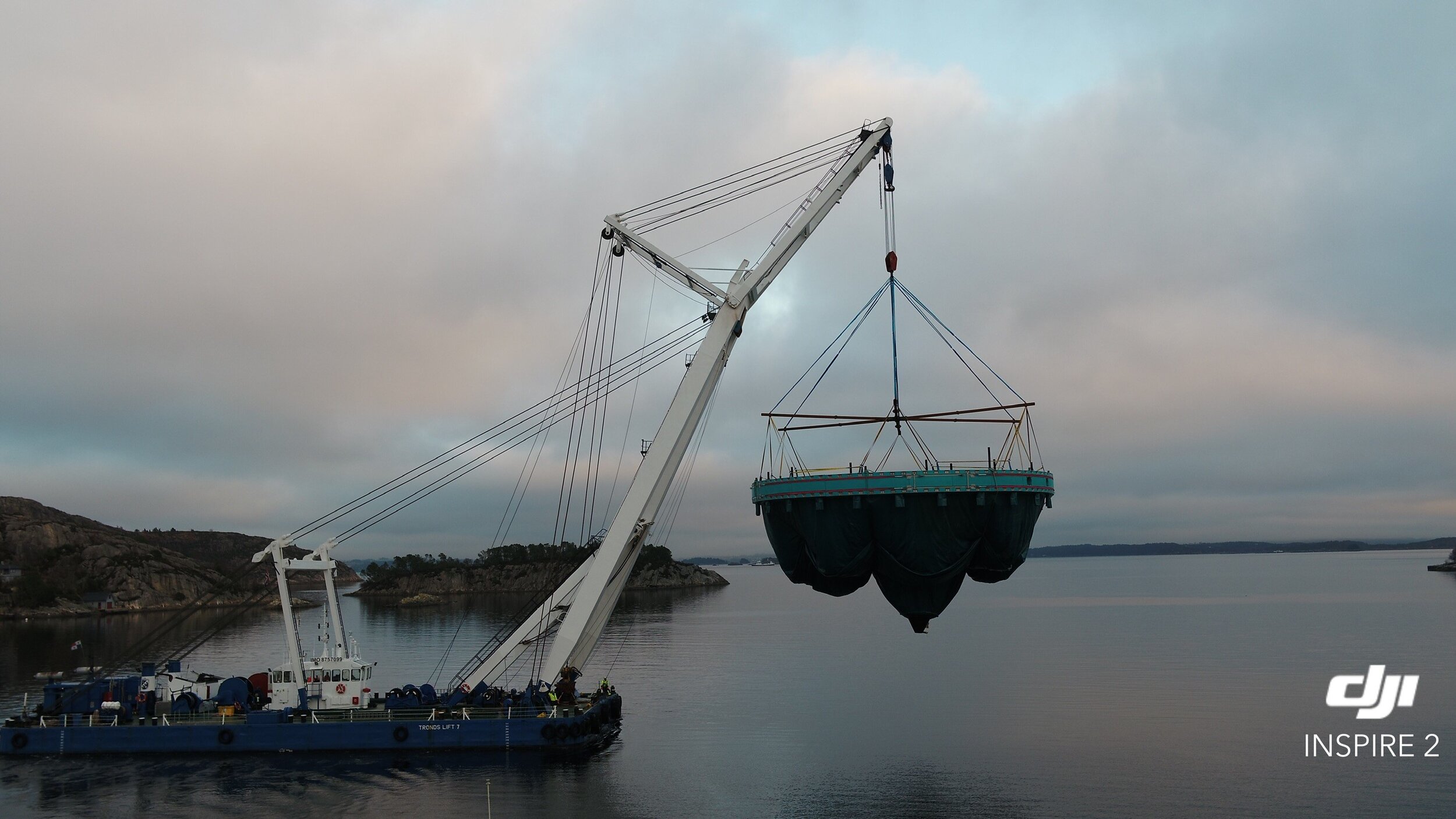
Merdslippen supplies floating closed fish farming facilities to Hardingsmolt for Christmas.
– The plan was for them to be delivered late in the fall, but we have had the timing pushed back so that delivery will be around Christmas time. It has taken time to complete the production documentation and certification, as well as to make molds for some of the main components. And it has also taken longer to obtain the material that the cloth bag itself will be coated with, says CEO Vidar Vangen in Merdslippen According to IntraFish.No, the molds are ready for trial casting and the fabric from which the cage will be made has been finished and tested. This means that we can start making the bags for the cages.
Each cage is around 6,000 cubic meters in volume. The fabric bag can either be placed freely in a frame mooring such as plastic rings or placed inside a steel structure.
Fish for spring
Chairman Ingebrigt Landa in Hardingsmolt expects to start stocking fish in the facility during the spring of 2018. The facility will be used on the so-called dark green concession the company was awarded in 2014. The location to be used is Koløy in Fitjar municipality in Sunnhordland. It has not yet been decided how large the fish will be in the closed facility.
– We are not starting out by producing fish for slaughter, so to speak. We will see a little bit at a time, and we must learn to use the equipment before we can take it further. The expectation is to get a decent production. We believe in closed production as a partial solution, but not a final solution. In the beginning, the fish will gradually be moved to open facilities. So far, no one has been able to repeat volumes of significance in closed facilities. We must take this gradually. The main issue is the lice problem, where closed production will be more protected. Closed facilities can also be an advantage in terms of growth. Our goal is to minimize the risk, says Landa.
Hardingsmolt is owned equally by Fremskridt Laks and Kobbevik and Furholmen Oppdrett where Landa is the managing director. He emphasizes that the project in hardingsmolt is independent of the smolt plans Kobbevik and Furuholmen have in the industrial park at Fitjar.
– This is an in-house project at Hardingssmolt. The fish for the facility is delivered from the smolt facility to Hardingsmolt , he says.
Experience from the 90s
Merdslippen has received funding from Innovation Norway for the development of the floating closed aquaculture facility. Back in the 1990s, they delivered facilities to Marine Production in Tvedestrand, which had good experience with the concept.
“Many good, but expensive, experiences have been gained along the way,” says Vangen.
– What is the difference between your facility and a facility like Ecomerden?
– I don't know other projects that well and therefore can't comment on them. I've only looked at the pictures of Ecomerden. In our facility, we have the ability to control and adjust the entire aquatic environment, both what is taken in and what is inside. You can do the same in our marine facility as in the most modern land-based facilities, without having to make similar interventions on land. In addition, the construction cost is significantly lower. What is in our disadvantage today is that you have to pay for concessions in the sea compared to them being free on land, Vangen answers.
Solid revenue growth last year
The company, which is located at Skaganeset in Sotra outside Bergen, had a good financial 2016 after several years of negative results.
Revenue growth was just under 77 percent last year. NOK 14.5 million in revenue resulted in an operating profit of NOK 2 million and an annual profit of NOK 1.2 million, compared to a deficit of over NOK 3 million in 2015.
– We are trying to develop closed facilities without taking on external investors, which is why the results in 2014 and 2015 have not been so good. Working with closed facilities has come at the expense of income-generating work. We have been compensated for that, even if it hurts the financial figures a little. Now we have created a foundation that can hopefully provide us with a foundation for further operation and development in the future, says Vangen and explains that they have had several serious inquiries about the facilities they are developing.
– Many people have great faith in us and what we are developing, he says, explaining that the development is part of a research project involving, among others, the University of Bergen and UNI Research.
In the annual report, the company writes that the outlook for the future is good and that projects related to zeroing, restoration and product certification of used fish farming facilities have been larger in the first half of this year than last year, and that a further increase is expected in the second half of the year.
The board also points out that there are large fluctuations in turnover since the number of fish farms to be maintained varies from year to year. Deliveries of floating facilities in the years ahead will hopefully provide more stable income.
